
A következő címkéjű bejegyzések mutatása: British Airways. Összes bejegyzés megjelenítése
A következő címkéjű bejegyzések mutatása: British Airways. Összes bejegyzés megjelenítése
Jumbo Jet Strip Down
BBC Two's Engineering Gaints programme features the enourmous work of a D-Check on British Airways' B747-400 G-CIVX.. :o

[Final report] BA 5390
Download it from here:
https://drive.google.com/open?id=0B8aiechh7K6iZFFJUTF5S21VTm8
Click here for the appendices:
https://drive.google.com/open?id=0B8aiechh7K6ib1RMdGFmYXJiTUU
https://drive.google.com/open?id=0B8aiechh7K6iZFFJUTF5S21VTm8
Click here for the appendices:
https://drive.google.com/open?id=0B8aiechh7K6ib1RMdGFmYXJiTUU
Blow(n) Out
Flight BA 5390 was featured on the Discovery Channel Canada programme Mayday (National Geographic Air Crash Investigation in other parts of the world), called "Blow Out", which was retitled Ripped From The Cockpit: BA Flight of Terror when broadcast on Channel 5 in the UK..
BA 5390
 |
| It started as an uneventful flight... |
British Airways Flight 5390 was a scheduled passenger flight operated by British Airways between Birmingham Airport in England and Málaga Airport in Spain. On 10 June 1990 an improperly installed panel of the windscreen failed, blowing the plane's captain, Tim Lancaster, halfway out of the aircraft. With Lancaster's body firmly pressed against the window frame for over twenty minutes, the first officer managed to perform an emergency landing at Southampton Airport with no loss of life.
Incident
The aircraft, County of South Glamorgan, captained by 42-year-old Tim Lancaster, who had logged 11,050 flight hours, and co-piloted by 39-year-old Alastair Atchison, who had logged 7,500 flight hours, was a BAC One-Eleven Series 528FL registered as G-BJRT. It took off at 07:20 local time, with 81 passengers, four cabin crew and two flight crew. Co-pilot Atchison handled a routine take-off, and relinquished control to Lancaster as the plane established itself in its climb. Both pilots subsequently released their shoulder harnesses, while Lancaster loosened his lap belt as well.
At 07:33, the cabin crew had begun to prepare for meal service. The plane had climbed to 17,300 feet (5,270 m) over Didcot, Oxfordshire. Suddenly, there was a loud bang, and the fuselage quickly filled with condensation. The left windscreen, on the captain's side of the cockpit, had separated from the forward fuselage. Lancaster was jerked out of his seat by the rushing air and forced head first out of the cockpit, his knees snagging onto the flight controls. This left him with his whole upper torso out of the aircraft, and only his legs inside. The door to the flight deck was blown out onto the radio and navigation console, blocking the throttle control, causing the aircraft to continue gaining speed as it descended, while papers and other debris in the passenger cabin began blowing towards the cockpit. On the flight deck at the time, flight attendant Nigel Ogden quickly latched his hands onto the captain's belt. Susan Price and another flight attendant began to reassure passengers, secure loose objects, and organise emergency positions. Meanwhile, Lancaster was being battered and frozen in the 345 mph wind, and was losing consciousness due to the thin air.
Atchison began an emergency descent, re-engaged the temporarily disabled autopilot, and broadcast a distress call. Due to rushing air on the flight deck, he was unable to hear the response from air traffic control. The difficulty in establishing two-way communication led to a delay in British Airways being informed of the emergency and consequently a delay in the implementation of the British Airways Emergency Procedure Information Centre plan.
 |
| Looks unbelievable but true! |
Ogden, still latched onto Lancaster, had begun to suffer from frostbite, bruising and exhaustion. He was relieved by the remaining two flight attendants. By this time Lancaster had already shifted an additional six to eight inches out the window. From the flight deck, the flight and cabin crew were able to view his head and torso through the left direct vision window. Lancaster's face was continuously hitting the direct vision window; when cabin crew saw this and noticed that Lancaster's eyes were opened but not blinking despite the force against the window, they assumed that Lancaster was dead. Atchison ordered the cabin crew to not release Lancaster's body despite the assumption of his death because he knew that releasing the body might cause it to fly into the left engine and cause an engine fire or failure which would cause further problems for Atchison in an already highly stressful environment.
Atchison eventually received clearance from air traffic control to land at Southampton, while the flight attendants managed in extreme conditions to free Lancaster's ankles from the flight controls and hold on to him for the remainder of the flight. By 07:55 the aircraft had landed safely on Runway 02 at Southampton. Passengers immediately disembarked from the front and rear stairs, and emergency crews retrieved Lancaster.
Injuries
Much to everyone's surprise, Lancaster was found to be alive, and was taken to Southampton General Hospital, where he was found to be suffering from frostbite, bruising and shock, and fractures to his right arm, left thumb and right wrist. Flight attendant Nigel Ogden suffered a dislocated shoulder, frostbitten face and some frostbite damage to his left eye. Everyone else left the aircraft unhurt.
Less than five months after the accident Lancaster was working again. He later retired from British Airways when he reached the company's mandatory retirement age of 55 at the time. In 2005 Lancaster was reported flying for easyJet.
Investigation
 |
| Not only smaller in diameter but shorter too... |
Accident investigators found that a replacement windscreen had been installed 27 hours before the flight, and that the procedure had been approved by the shift maintenance manager. However, 84 of the 90 windscreen retention bolts were 0.026 inches (0.66 mm) too small in diameter, while the remaining six were 0.1 inches (2.5 mm) too short. The investigation revealed that the previous windscreen had been fitted with incorrect bolts, which had been replaced on a "like for like" basis by the shift maintenance manager without reference to the maintenance documentation, in order to save time as the plane was due to take off soon and there was a tight schedule. The air pressure difference between the cabin and the outside during the flight proved to be too much, leading to the failure of the windscreen. The incident also brought to attention a design flaw in the aircraft of the windscreen being secured from the outside of the aircraft, putting a greater pressure on the bolts than if they were secured from the inside.
Investigators found the British Airways Birmingham Airport shift maintenance manager responsible for installing the incorrect bolts during the windscreen replacement and for failing to follow official British Airways policies. They also found fault with British Airways' policies, which should have required testing or verification by another individual for this critical task. Finally, investigators found the local Birmingham Airport management responsible for not directly monitoring the shift maintenance manager's working practices.
Safety recommendations
Investigators made eight safety recommendations in the final accident report:
British Airways
- Review their quality assurance system and encourage engineers to provide feedback.
- Review the need to introduce job descriptions and terms of reference for engineering grades Shift Maintenance Manager and above.
- Review their product sample procedure to achieve independent assessment of standards and to conduct an in-depth audit into the work practices at Birmingham Airport.
Civil Aviation Authority
- Examine the continued viability of self-certification with regards to safety critical tasks on aircraft.
- Review the purpose and scope of the FOI 7 Supervisory Visit.
- Consider the need for the periodic training and testing of engineers.
- Recognise the need for the use of corrective glasses, if prescribed, in association with aircraft engineering tasks.
- Ensure that, prior to the issue of an air traffic control rating, a candidate shall undergo an approved course including training in both the theoretical and practical handling of emergency situations.
Awards
First Officer Alastair Stuart Atchison and cabin crew member Susan Gibbins were awarded the Queen's Commendation for Valuable Service in the Air.
Atchison was awarded a 1992 Polaris Award for his ability and heroism.
Source:
https://en.wikipedia.org/wiki/British_Airways_Flight_5390
Long Haul on a Short Plane
An Analysis and Trip Report of British Airways JFK-LCY Service
By Chris Sloan / Published June 9, 2014
By Chris Sloan / Published June 9, 2014

Today there are such luxuries as private cocoon like suite, advanced in-flight entertainment systems, and high-speed in-flight connectivity. Yet despite being from the pre-internet era, Concorde did something nobody has been able to duplicate: being a time machine. Appropriately Concorde flights were given the airline’s most prestigious flight numbers, such as BA001 and BA002.
Beyond the famous cadre of celebrities who made the supersonic jet so glamorous, Concorde was a C-Suite executive’s capitalist tool. Executives could leave London in the morning, have a business lunch, crucial meeting, or sign a contract, and return home to London for dinner.
On October 24, 2003 after some 50,000 flights and 2.5 million passengers, BA’s iconic Concorde conducted its last scheduled champagne-soaked crossing between London and New York. A victim of changing times, the jet was scuttled due to rising fuel prices, environmental concerns, heavy operating costs because of age and maintenance, and the triumph of the internet age. The need for Mach 2 speed could no longer be justified.
An era had come to a close, yielding to slower, more pedestrian forms of intercontinental jet travel. Many felt that technology had actually taken a step backwards. C Suite executives hopping between Wall Street and The City would have to “make due” in subsonic aircraft, albeit in lie-flat seats in First and Business with the high-end, world-renowned service that BA is known for.
A New Product for a New Age

Right from the get go this service was designed to link the hearts of the world’s two financial capitals, with London City located, quite literally, in the heart of the UK city’s financial district. Somewhat courageously, this service, directly aimed at the financial industry, was launched in the midst of a raging recession.
On the face of it, this didn’t seem like a new idea. MaxJet and Eos both operated an all business class service between New York from an alternative airport: London Stansted, a fairly distant airport located to the north of Central London. Both operated large aircraft such as the 757 and 767, and their business models revolved around a discounted business class fare rather than as a premium priced offering. MaxJet and Eos both lacked any sort of meaningful network and critical mass to attract business contracts or flyer loyalty. These factors, coupled with bad timing and economic headwinds resulted in their demise after just a few years of service in the bust of late 2007 and 2008.
British Airways’ London City service on the other hand has been a profitable operation. It boasts a relatively high load factor thanks to squarely marketing to the high-yield financial services industry, some of whom commute each week between the two cities. Perhaps more importantly, BA is able to use the London City service as an exclusive marketing edge on both ends of the pond that no one else can offer.
The headline of the service is clearly convenience, catering to a very specific customer. Passengers departing either city are literally able to show up at the airport less than an hour before departure, something almost unheard of. At New York JFK, a full dinner at the airport is complimentary for early arrivers, allowing them to take full advantage of the short flying time to sleep while onboard.
The two flights from New York JFK, BA002 and BA004, depart at 7:00pm and 9:45pm respectively. With a quoted gate-to-gate block time of 7 hours, 15 minutes, the in-flight service is tailored for maximum sleep time so the passengers can hit the ground rested and running for a full day’s business the next day. Passengers conveniently clear customs and claim their bags so quickly that they can be at their desks or a hotel arrivals center an hour after landing in London.
The two flights from London City to JFK, BA 001 and BA003, depart at 9:45am and 4:00pm respectively. Due to a required technical stop at Shannon, Ireland for refueling, the flight is quoted at 9 hours, 10 minutes, nearly two hours longer than a normal widebody flight. BA puts the refueling stop to clever use, having passengers clear U.S. customs and immigration during the brief stop in Shannon. This is a huge boon to travelers wishing to avoid long waits upon arrival in the U.S.
Unfortunately, due to U.S. government cutbacks following sequestration, the afternoon flight of BA003 is no longer supported by this plan. Regardless, the very short check-in time and close-in location at London City more than makes up the difference for the longer block time. The westbound, mostly daytime, flight to New York allows for a very different, outstanding in-flight service and makes the time past quickly. Indeed with three cabin attendants to only 32 passengers the intimate cabin and attention is more like an executive jet than a commercial flight. As an added but expensive productivity enhancement, the London City flights offer a form of in-flight connectivity for email and text. No other BA aircraft are so equipped.
One would think this exclusive niche service targeted to the financial industry would come at a sizeable premium over BA’s Club World product, but that isn’t typically the case. The carrier claims that there is no pricing premium between a LCY Club World and a standard Club World ticket, though of course there are many factors that enter in actual ticket pricing.
A quick search on BA.com revealed an April 14th outbound and April 22nd return fully flexible round-trip ticket priced at $13,982. The same site quoted a normal JFK-LHR round-trip Club World ticket with a similar schedule at $13,360, including taxes. Of course, many of the passengers are flying on discounted corporate rates, which we will delve into later with our market analysis.
A Service like None Other

First time London City passengers more accustomed to wide-body aircraft on long-haul flights reportedly sometimes board the stubby narrow body A318 and ask “Where’s the rest of the plane?” The two “Baby Busses” operate a schedule of two round-trips per day Monday-Friday and one on Sunday. Both aircraft are ferried to Gatwick on Saturdays for maintenance, which is a low traffic day for this market. Besides, London City Airport is closed midday Saturday to midday Sunday. Sunday afternoon, LCY-JFK flights resume with BA003.
From a pilot’s perspective, this is a very unique operation. Optimized for operations into LCY’s 4,948’ long, 100’ wide narrow runway, the two A318s, G-EUNA and G-EUNB, are the only A320 family aircraft in the world equipped with steep approach software. The software modifies the control laws of the A318 when the function is selected by the pilots, automatically deploying some of the wing spoiler panels to provide additional drag when the aircraft is on final approach. The modification also provides alternative audio alerts to the crew and modifies spoiler deployment automatically below 120 feet as the aircraft lands.
This European Air Safety Agency certified software allows the A318 to perform approaches at descent angles of up to 5.5°, as opposed to the standard 3° for a normal approach. This also aids in noise abatement for this very urban-located airport. As we’ll detail later in the flight review, the take-offs and landings are quite thrilling, analogous to landing on an aircraft carrier, though very smooth.

The pilots who fly this mission are the only ones in the world that regularly fly the entire A318/A319/A320/A321 family in scheduled service. Only 50 pilots out of approximately 1000 A320 series qualified aviators at BA are able to secure this very senior, in demand bid. In fact, the A318 has the highest seniority of any BA fleet type. While both captains and co-pilots can perform take-offs, only the captain typically performs the precision landing at London City, though co-pilots are trained to perform it and practice it in the simulator.
Most crews are able to work two to three crossings per month. The rest of the time they fly normal short and medium haul schedules. Because of the specialized approach into LCY, the flight crews not only train in the simulator but in actual training flights with no passengers aboard, often during the plane’s weekend down time.
Flights from JFK to LCY typically carry 17 tons of fuel. On the London to New York segment, LCY’s short runway doesn’t allow the aircraft to take on a full load of fuel so 6 tons is more than ample to reach Shannon. Besides, the A318 doesn’t have the range, when fully loaded, to fly westbound from London City to New York owing to headwinds and weight restrictions at LCY. On the Shannon SNN-JFK segment, somewhere around 17-20 tons of fuel is taken up depending on forecasts.
The Gatwick based cabin crews are generally very senior as well, with only 250 on roster. This flight is considered so premium and is in such high demand that BA employees are not given free travel privileges on it. An interesting footnote is that with only two A318s in the fleet, there is no slack in the system when an aircraft is out of service for maintenance, so the airline times the heavier checks during lower demand times of the year and will only operate one aircraft. Against the backdrop of the dominant British Airways / American Airlines North Atlantic joint venture, there is no shortage of alternative flights for customers.
The Business Case for a Flight That Truly Means Business
The JFK-LCY nonstop is a small player in an overall sense, and also in a premium sense, as the following tables illustrate:
Route
|
Weekly Seats
|
Capacity Share
|
JFK-LHR
|
38438
|
68.8%
|
EWR-LHR
|
16219
|
29.0%
|
JFK-LCY
|
352
|
0.6%
|
JFK-LGW
|
873
|
1.6%
|
TOTAL
|
55882
|
Route
|
Weekly Premium Seats
|
Premium Capacity Share
|
JFK-LHR
|
8202
|
73.5%
|
EWR-LHR
|
2598
|
23.3%
|
JFK-LCY
|
352
|
3.2%
|
JFK-LGW
|
0
|
0.0%
|
TOTAL
|
11152
|
At 0.6% of total capacity and 3.2% of premium capacity, the LCY-JFK flights are all but irrelevant contributors to the volume on this city-pair market. That being said, we believe that the flights are profitable in their own right, and they of course play an enormous strategic role in one of the world’s most important business travel markets.
According to our analysis, to operate JFK-LCY nonstop using the A318, it costs roughly $31,200 per flight inclusive of ownership costs, assuming a standard valuation for British Airways’ A318s. The LCY-SNN-JFK flights meanwhile cost roughly $35,000, including ownership costs, due to added costs of operating via Shannon.
For January-August 2013, British Airways had the following operational characteristics on JFK-LCY. The carrier offered, 9,792 seats, filling 7,533 of them for a 76.93% load factor.
*Readers please note that all of these figures are estimate and subject to a wide potential margin of error. Our fare estimates are conservative.
Thus to break even in the first nine months of 2013, BA needed an average roundtrip revenue of $2,960 per passenger (excluding government taxes – which are typically around 20% of the ticket). So in this case, an average roundtrip fare of $3,550 means the carrier breaks even.
Keep in mind that if you adjust for seasonality (missing Oct-Dec, the figures will be lower during that period), the loads likely come down to 72-73%, and applying the same fixes yields a required break even fare of roughly $3,800.
The average fare, we estimate, is roughly $6,500 roundtrip, so you’re talking about 38% operating margins (at least double that of British Airways’ overall long haul network). The only adjustment is that if you look at the summer, R/T fares are 5-6k, so an overall average R/T fare for the year of $7,500 is reasonable, especially given that loads are highest in the summer.
The route is profitable; we’d estimate to the tune of $10-15 million a year net contribution to the bottom line once you include structural costs. Moreover, it plays an enormous strategic role in making the British Airways – American partnership the preferred operator in the lucrative New York City – London market, especially for the financial industry. At least another $3-5 million in profitability is tied to the boosts received due to corporate contracts and frequent flyer loyalty tied to the availability of this service.
Outbound Trip Report: New York JFK to London City LCY
The more I learned about this unique service, the more determined I needed to try it for myself. In this case, I would be flying both outbound and inbound flights as the experience is so different, depending on which direction one is heading.

There was no queue at the dedicated London City check-in desk. After checking my bag, for testing purposes only I assure you, I was through security and in BA’s sprawling Galleries Lounge just 15 minutes after arriving at the curb. With dinner waiting and time ticking, I undertook a cursory romp through BA’s lounge. Though crowded, and not as exclusive as the fabled Concorde Lounge, Galleries is a beautifully appointed, significant upgrade from its US domestic carrier counterpart. A tempting array of snacks and complimentary top shelf spirits and wine graced a number of bars, speedy Wi-Fi, power plugs o’plenty, and even an Elemis travel spa, were on offer. Though tempted for the massage and facial, I decided to remain on the program and stroll over to the pre-flight dining room.
This buffet style meal service offered a bit of something for all clientele, from vegetarian dishes such as eggplant roasted pepper and feta cheese tart, to kahari braised lamb with apricots, and seared arctic-char with French lentil tomato veloute’. For those with Asian tastes, a full line of curry, teriyaki, and noodle dishes were there for the indulgence.
Out of a sense of duty, I sampled small portions of just about everything including the deserts dubbed “Finale” which included date-nut bread pudding, chocolate mousse, and a Hudson valley farm cheese plate. A nice glass of Dom complimented this feast. A particular Monty Python sketch came to mind as I was forced to loosen my belt a bit. In one word, my review: “excellent”, but my fear: no room left in the belly to sample the so called “nightcap” service once onboard. Would my palette be able to overrule my already satiated appetite later?
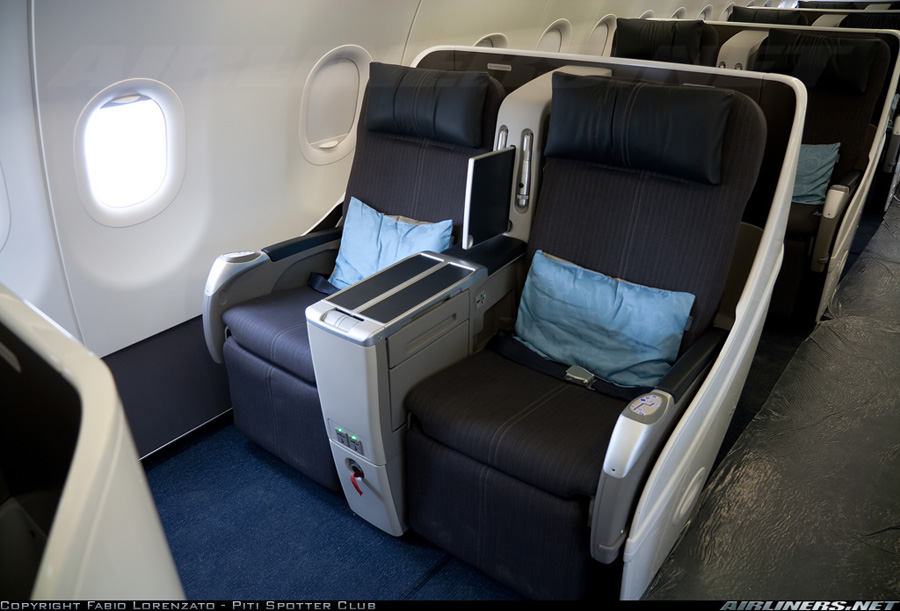
The leisurely boarding took less than ten minutes. With the dark blue mood lighting, the soothing boarding theme of BA’s signature “Flower duet” by Lakme, and only fifteen passengers onboard, was BA trying to already subtly lull us all into sleep? While we waited for the cabin to be buttoned up, we were served champagne and our “nightcap” orders were taken. While examining the generous menu, it became crystal clear “nightcap” at BA means a lot more than a light snack and drink. The flight is typically catered for less than full capacity, as half of the passengers chose to sleep rather than eat, especially on the later evening flight. Each passenger was asked if they wished to be awoken for breakfast to maximize precious hours of sleep in this quick six hour and twenty minute crossing.
Sitting on our seats were Elemis amenity kits, nothing unusual in these, but the branded moisturizer was a very nice treat. Noise cancelling headphones with a multi-prong jack were sitting in the seatback along with the well regarded “High Life” in-flight magazine.
With no overhead in-flight entertainment center, we had an old school “live” safety briefing, very unusual for a long-haul flight. After a slight delay due to weather, we pushed back at 7:20pm and were airborne in less than ten minutes, avoiding the usual evening parking lot that is JFK. I actually was curious if this time sensitive flight was granted some sort of special priority. With the cabin lights immediately dimmed shortly after take-off, at least half of the cabin drifted off to dream land.

BA has left no detail un-turned especially with regards to sleep. Each of the two galleys features double sets of curtains with a dark threshold to make absolutely certain no light leaks into the cabin. The lavatory lights are dimmed very low as well when the door is open to the cabin. Thus with my resistance to sleep wearing low, I endeavor to sample the evening’s in-flight entertainment.
Due to weight and cost issues, there is no embedded IFE on the A318 fleet. Originally using older digital video players, BA switched to iPads in the fall of 2011. They are pre-stocked with an ample selection of up to 20 movies, 40 TV series, four games, and 32 music channels, though no moving map. As many passengers carry their own devices, sleep, or work the selection doesn’t need to quite reach the level of the carrier’s normal embedded IFE’s. Fans of “Downton Abbey” will be pleased to know that the series is represented here, appropriately enough.
I opened the side armrest thinking there was some sort of mounting bracket for the iPad but found these to be incompatible arms for the previous IFE. For those wishing to use their own devices US, UK, and EU power sockets are available at every seat – no adapter needed, though there are no USB plugs.
There was still one more feature unique to the London City service that I needed to try: On-Air, BA’s unusual answer to connectivity. Surprisingly, the two A318s are the only aircraft in BA’s worldwide fleet with in-flight connectivity. The rather pricey On-Air service is designed only for emails and SMS with mobile phones, no web surfing. You leave on your phone’s cellular data function and turn on roaming as opposed to Wi-Fi. Thankfully the system doesn’t support voice calls. Innovative when introduced in 2009, in an age before over-the-ocean satellite Ka-based in-flight internet, it is slow and in tonight’s case not working.
That would have to wait for the return flight home. It being a Friday night, there wasn’t anything pressing anyway. I reclined my Club World seat into a fully lie-flat 72” bed and shortly thereafter was lulled into dreamland by slight chop as we cruised at 39,000 feet and 550 mph over the North Atlantic. Even during turbulence or meal service the cabin is noticeably quiet.
An hour before arrival into London City, those who had opted to be awoken for breakfast were served fresh fruit, smoothies, and a bacon and egg sandwich. This hardy meal hit the spot and would be my final meal until dinner later that night. Caution: calorie and carb counters may find this flight challenging. For those wishing to sleep, a complimentary breakfast is available upon arrival at the arrivals hotel.
We began our gradual descent over the Irish Sea with 34 minutes left to go in the flight. The dimmed cabin lights seamlessly came up a few minutes later and the passengers began to stir from their slumber. The conscientious crew embodying BA’s longtime motto “To Fly. To Serve.” were still serving late breakfasts in the descent, not wishing to deny anyone of the most important meal of the day.

As there are no taxiways in this runway built out in the Thames, the plane does a 180 degree turn and backtracks partway down the runway to turn off on the tarmac. At 6:58AM the engines are shut down and the passengers alight from the plane down air-stairs to a waiting bus to the diminutive terminal.
An incredible fourteen minutes later, I have cleared immigration, collected my bags and cleared customs. Some passengers head to the nearby Raddison Blu New Edwardian Hotel where BA has contracted for an arrivals service of showers, gym and a breakfast. If this weren’t a Saturday morning, others would be in their officers in The City, Canary Warf, or the Docklands within 15 minutes. As for me, I walk 300 feet to the Terminal’s train station for the Docklands Light Railway. After transferring to the Tube, I am at the door of my hotel in the West End of London less than an hour after landing. This first leg delivered on both British Airways’ expected high standard of service and a precision and a seamless efficient product engineered for a very specific market that would be the envy of any airline.
Return Trip Report: London City LCY to New York JFK via Shannon, Ireland SNN

This will prove to be a much different experience then the overnight JFK-LCY flight a few days ago. After a quick ride from my hotel near Victoria Park on the London Underground and Docklands Railway, I arrive at London City an hour before the scheduled 9:45am local time departure of BA001. Remarkably, passengers on the westbound flights to New York only have to check-in 15 minutes prior to departure, or 20 minutes if they are checking luggage. What other flight, including domestic, anywhere, allows such a late check-in?
Ten minutes after turning up at the dedicated counters for JFK-bound passengers and breezing through UK immigration and security, I am at the tarmac level Gate 24. This gate, specially configured for just these flights, masquerades as a mini-lounge. One can indulge in champagne, a cold fish platter, cappuccino, yogurt parfaits, smoothies, high-speed Wi-Fi and outstanding views of the ramp and runways. BA CityFlyer E-Jets and BA’s other Airbus A318, G-EUNA that I flew over on prove to be the stars of the show. G-EUNA pulls in and does an impossibly tight 180 degree turn on the cramped ramp unassisted. Flight crews operating into LCY are clearly very skilled not only for landings and take-offs, but in navigating the small and crowded ramp.
Boarding is called a mere ten minutes before scheduled departure. Instead of taking the bus, we are able to walk about 100 feet to the air-stairs and a quick climb up to BA Airbus A318 G-EUNB. With “Swiss precision” but on a UK airline, the boarding process takes five minutes with engines starting just two minutes after it is completed.
Traveling in a low demand season and mid-week, the cabin is a little less than half-full, with fifteen passengers and five crew. My Club World seat 5J (and 5K) offers a great view of the wing. We immediately begin our trek down the runway and once again the flight crew executes a 180 degree maneuver to line up for take-off. At 10:02AM, just ten minutes after the A318’s CFM56-5B9 engines are spooled up, and our take-off roll commences. With a very light fuel and passenger load, V2 take-off speed comes at 112 knots, we rotate, and the twin CFM’s effortlessly have us airborne, using less than half of the runway.

Just eleven minutes after take-off while still in the climb, the seatbelt sign is extinguished and the in-flight service begins, the first of three we will experience today on our trip to New York. Upon reviewing the menu and imbibing in a Champagne Tattinger Brut Reserve NV, I preemptively loosen my belt again to deal with the coming culinary tsunami. Again, this is not for my enjoyment but my duty to you, my dear reader.
To tide us over, we are served canapés including smoked salmon and trout, prosciutto, and feta cheese complimented with an exotic fruit brochette. This savory, tangy delight is without question the best appetizer I have ever had on an airplane in terms of presentation and taste. I would have asked for seconds, but that would be déclassé and there were still two full meals ahead of us. Additionally, I had run out of belt notches.
The pampering but never cloying crew took our orders for the first meal of the SNN-JFK segment. I suffer from some notable food allergies, so when I asked about the ingredients, the very patient flight attendant produced a photo menu for people with food allergies listing every ingredient of every dish. I had never seen this before.
Quite different from the nighttime Friday flight, many passengers opt to work and decline the iPads. With the office opening up back home, I decided to try the On-Air in-flight connectivity system to check some emails and texts. The emails trickled in before stopping as my phone intermittently lost connection, before regaining it again. This temperamental and expensive service is better than nothing, but is clearly the major weak link in the otherwise nearly flawless service. Given the clientele and advances in connectivity since the service first launched in 2009, BA could afford to upgrade not only the A318 fleet but the rest of the non-connectivity enabled fleet.
At 10:50am we began our descent through rough air into Shannon. The “Baby Bus” A318 handles the chop with surprising aplomb and after exactly 90 minutes we grease the runway for our quick stopover.
Shannon is an airline geeks paradise with numerous types undergoing work or stored at various aircraft maintenance, repair, and overhaul MRO’s at the airport. Lufthansa Technik and Russian airline Transaero both operate MRO’s at Shannon. But with less than 45 minutes on the ground at Shannon, there won’t be much time for plane-spotting or anything else.
 Everyone, including the flight crew, disembarks with their belongings during the refueling for the clever and convenient US immigrations and customs pre-clearance. Due to the lack of an international officer and the possibility of timing out if there was a diversion due the duration of the flight, there is a crew change of pilots here.
After just 45 minutes in Ireland, at precisely noon local time, we have re-boarded and are bound for New York for the 7 hour, 5 minute flight. Nearly fully loaded with 19 tons of Jet A fuel, our take-off roll is more than double the time at London City at 38 seconds and V1 doesn’t come until 143 knots. Even nearly fully loaded with fuel, we reached the jet stream optimized cruising altitude of 39,000 feet in just 19 minutes.
Following the obligatory warm towels, the decadent lunch service begins. With BA001 being a long, all-daylight flight, the meal service is an extended affair. We begin with mixed nuts and champagne. This time I opt for Champagne de Castelnau Brut Rose. I am offered a tasting sample before my glass is filled. This small touch contributes to the highly personalized, professionally executed service that is a perfect fit for this routing.
The menu cuisine and presentation are especially designed for London City as well. The prelude to my meal is a fresh seasonal salad topped with a tangy apple balsamic dressing and three bread choices, including pumpkin seed wheat. My carbs meter is now off the charts!

Absolutely stuffed, I declined the deserts and fruit course, holding out for what the High Tea service had in store. The night before I had an amazing dinner at London’s famed Quo Vodis. I am only half-joking when I say that the chefs at flight kitchen at London City could contribute to the Quo.
After the one-hour meal service, the cabin crew passed out chocolates and bottles of water and basically disappeared unless called for until tea. Most passengers were involved in their work or absorbed in a movie, while a few slept. They were probably happy to be not be disturbed. Even with a full load of 32, a regular passenger told me that flight is always very quiet and serene.
We crossed over into the Northern Maine with one hour remaining in the flight. The moment had arrived for the vaunted High Tea Service. A meal unto itself, BA’s version of Afternoon Tea is more a meal service fit for the Ritz, Mayfair, or maybe even Buckingham Palace. A plate of delicate sandwiches featuring roast beef with tartar sauce, wasabi chicken, tuna with sweet corn, and mature cheddar with caramel onion chutney were just exquisite.
These savories were followed up with traditional antipasti prepared with grilled king prawn, prosciutto di Parma, Vitello tonnato, and beetroot with goat’s cheese. What’s afternoon tea without sweets? I sampled one bite each of the homemade plain or lemon and date scones served warm with clotted cream and strawberry preserves, fearing I had gained five pounds just on this flight. There was absolutely no way I could even consider the afternoon tea pastries featuring Dundee cake and flamed lemon meringue tartlet. I have written many trip reports but this one was quickly becoming a restaurant review for a tasting menu.

Source:
http://airwaysnews.com/blog/2014/06/09/long-haul-on-a-short-plane-an-analysis-and-trip-report-part-one/
http://airwaysnews.com/blog/2014/06/11/long-haul-on-a-short-plane-an-analysis-and-trip-report-part-two/
http://airwaysnews.com/blog/2014/06/12/long-haul-on-a-short-plane-an-analysis-and-trip-report-part-three/
http://airwaysnews.com/blog/2014/06/13/long-haul-on-a-short-plane-an-analysis-and-trip-report-part-four/
[Lajstromjelek nyomában] G-EUPC avagy a szentjánosbogár
 |
| A G-EUPC lajstromjelű 'The Firefly'-nak keresztelt A319-es 1999. végén.. |
 |
| ..került a British Airways flottájába. Érdekessége, hogy a 'The Dove' vagyis.. |
 |
| ..galamb nevű másik A319-essel egyetemben, a 2012-es londoni nyári olimpiai.. |
 |
| ..játékok alatt, számos fontos járat teljesítését volt hivatott ellátni. Ezek közül.. |
 |
| ..is kiemelendő, hogy 2012. május 18-án számos sportoló híresség és Katalin.. |
 |
| hercegnő kíséretében ez a gép hozta el Athénból az olimpiai lángot. Az angol.. |
 |
| ..légügyi hatóság különleges, egyedi engedélyével vált lehetővé, hogy a repü- |
 |
| lőút alatt sem kellett eloltani a lángot, ugyanis a fáklya egy speciális, úgyn. |
 |
| Davy lámpában került elhelyezésre, mely 30 órán át füstmentesen képes táp- |
 |
| lálni a tüzet. A Pascal Anson és Tracey Emin tervezte festés mára már eltűnt... |
A380 vs. Red Arrows kötelékrepülés
A British Airways nemrég átvett első A380-asának kötelékrepülése a Red Arrows Hawk-jaival a 2013-as Royal International Air Tattoo-n..
[Tudtad-e?]
A Concorde leköszönésével a British Airways 2009-ben a szuperszonikus transzatlanti járatok helyét két módosított, különleges szolgáltatásokat kínáló, 32 üléses A318 Corporate Jet vette át. A BA001 és BA003 ill. a BA002 és BA004-es számú járatok egy 45 perces közbülső, írországi leszállás beiktatásával teljesítik a London City - New York JFK távot. A shannoni tankolás alatt az amerikai vámhivatali beléptetés is megtörténik, így az utas a londoni felszállástól számított 9h 15-20p elteltével már további procedúrák nélkül, egyszerű belföldi utasként érkezik New Yorkba. Visszaúton a járat a jetstreamek kihasználásával, ha nem is 3h, mint hajdanán a Concorde, de az íroszági leszállást megspórolva mindössze 7h 5-10p alatt teszi meg az utat. Az egyúti jegyek ára ennek megfelelően több mint másfél millió forint...
"The Dove"
Így készült a British Airways A319-esének a londoni nyári olimpiára szánt különleges festése...
 |
| Egyedinek egyedi, de öt színes karika nem lett volna jobb? |
BA 038
Hogy ne csak mindig szomorú dolgokat írjak vagy mutassak, itt van ez a vicces videó. Csak azért merem feltenni, mert a fedélzeten tartózkodók egytől egyig sértetlenül megúszták a balesetet...
Concorde Ferihegyen 1985
1985. szeptember 14-én szállt le először Concorde Ferihegyen. A repülőgép a British Airways színeit viselte...
Feliratkozás:
Bejegyzések (Atom)